
Things to Do in Minnesota's Prairielands Region
Only about four percent of America’s native tallgrass prairie remains — and Minnesota is the best place to experience it. From wispy wildflowers to free-roaming bison, there’s a reason Laura Ingalls Wilder drew inspiration from this scenic slice of the state.
As another American author, Walt Whitman, once wrote, “The prairie doesn’t shout. But listen closely. It whispers. And a whisper can be a powerful thing.” In Minnesota’s Prairielands, there’s plenty to hear — if you know how to listen.
-
Visit Pipestone National Monument
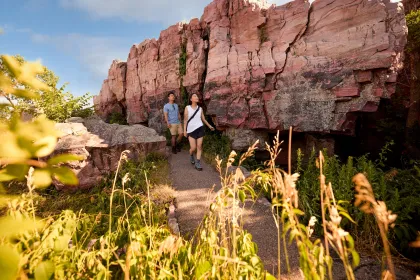
 A couple hikers at Pipestone National Monument / Credit: Paul Vincent
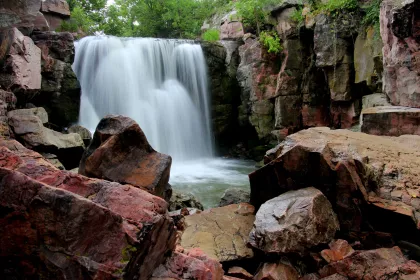
One of only six national park sites in Minnesota, Pipestone National Monument is a storied landscape where history, culture and nature come together. Famous for its namesake quarries, the site also features rare native tallgrass prairie, dramatic quartzite formations and the majestic Winnewissa Falls.
Start your visit at the visitor center to explore archaeological discoveries and learn about the importance of pipestone to the many Tribal Nations connected to this place. For more than 3,000 years, Indigenous people have come to these quarries to mine pipestone, or catlinite, used to craft pipes, jewelry and other sacred objects.
Pipestone is a naturally occurring mudstone, typically reddish-brown in color. Many Tribal Nations believe the stone represents the flesh and blood of their ancestors, making the quarries sacred ground.
Winnewissa Falls at Pipestone National Monument / Credit: Myra SmisekThe tradition of quarrying pipestone continues today. Tribal members from across the country travel here to quarry stone using sledgehammers, chisels and other handheld tools, and the waiting list for a permit can stretch up to 10 years. From April through October, artisans from local Tribal Nations demonstrate pipestone carving at the visitor center.
After learning about the monument’s namesake stone, walk the Circle Trail to see active quarry pits, Winnewissa Falls (about a half-mile from the visitor center), native prairie and wildlife. You can explore on a self-guided hike, or join a 30- to 60-minute guided walk. No entrance pass is required, and the site is open year-round.
In late summer and early fall, a large patch of sumac turns a vivid red. Some Tribal Nations use the dried leaves and branches for pipe use, food flavoring and more. In winter, visitors can snowshoe throughout the park.
-
Romanticize prairie life
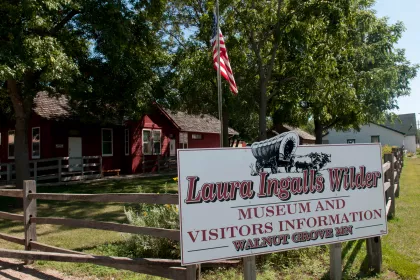
Laura Ingalls Wilder MuseumIn southwest Minnesota, cottagecore isn’t a trend — it’s a way of life. In the 1870s, Laura Ingalls Wilder lived in the small town of Walnut Grove, where her experiences inspired “On the Banks of Plum Creek,” the fourth book in her Little House series. Today, visitors can follow in her footsteps and explore pioneer life at the Laura Ingalls Wilder Museum.
Across eight buildings, the museum tells the story of the Ingalls family’s life in Walnut Grove through historic artifacts, outbuildings and memorabilia from the “Little House on the Prairie” TV series. Visitors can explore life-size replicas of a settler’s home, schoolhouse, church and dugout — similar to the one the family lived in when they first arrived at Plum Creek.
Antiques, exhibits on pioneer life, a children’s play area, and a gift shop round out the experience. The museum is open April through December; the gift shop is open February through December (see the website for exact hours).
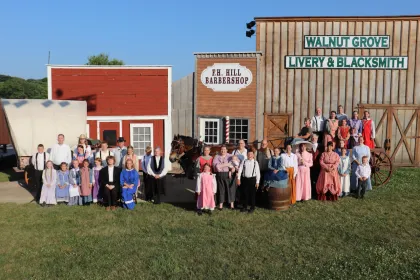
The cast of Walnut Grove's Wilder PageantWhile Walnut Grove is worth a visit year-round, for three weekends each July, the Wilder Pageant offers a particularly immersive way to relive the family’s stories through live outdoor performances. The shows — which draw international audiences — take place in a hillside amphitheater west of town on the banks of Plum Creek.
During your trip, visit the original dugout site just outside town, the Fond Memories gift shop, and the Sod House on the Prairie in nearby Sanborn. After a day of time travel, grab a coffee or a meal at Half Pint Coffee Co. or Walnut Grove Bar & Grill.
If you’re not quite ready to leave Laura behind, continue along the Laura Ingalls Wilder Historic Highway — a roughly 300-mile stretch of U.S. Route 14 from De Smet, South Dakota, to Pepin, Wisconsin. The route loosely traces the Ingalls family’s journey across the Upper Midwest and connects several key sites from their lives. In Minnesota, Spring Valley — in the state’s southeast corner — is another stop, home to a museum dedicated to the Wilder family.
-
Hang out with cacti blooms and bison
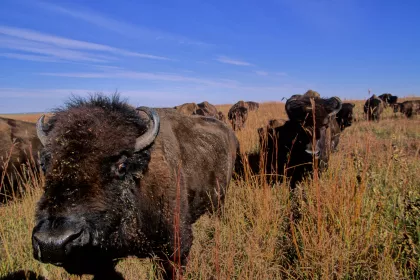
Bison herd at Blue Mounds State ParkThere’s nothing quite like seeing bison on the prairie — and Blue Mounds State Park is one of the best places in the country to do it. The park is home to one of the world’s last remaining herds of purebred bison, part of the Minnesota Bison Conservation Herd. This collaborative effort — involving local, state and national partners — helps preserve the herd’s genetic diversity and long-term sustainability, with roughly 80 to 90 animals roaming the prairie.
To see the bison, hike the Western Loop Trail (bring binoculars), stop at the observation deck to use a spotting scope, or book the park’s Prairie and Bison Tour — a naturalist-guided, 90-minute drive through the bison range that runs May through October.
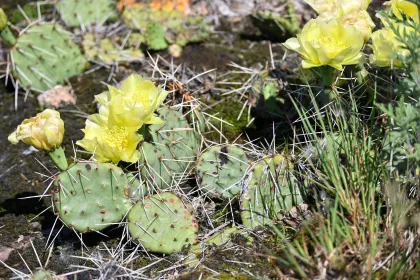
Prickly pear cacti at Blue Mounds State Park / Credit: Minnesota State Parks & TrailsThere’s more than bison at Blue Mounds. The park also features more than 1,500 acres of tallgrass prairie and a mile-long quartzite cliff that rises 100 feet — the landmark that inspired the park’s name. Early settlers traveling west in the 1860s and 1870s noted the rock’s bluish hue and dubbed it “the Blue Mound.” In June and July, visitors may also spot prickly pear cactus in bloom, and birdwatchers often come to see nesting blue grosbeaks and other prairie species.
Open year-round, Blue Mounds State Park offers accessible camping and hiking trails. In winter, trails are also open for snowmobiling.
-
Hunt for pheasants and other upland birds
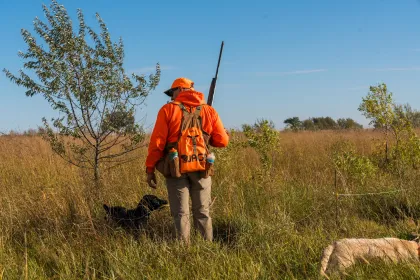
The 2025 Governor's Pheasant Hunting Opener in Ortonville / Credit: Riley HallawayUnlike many states, Minnesota’s bird-hunting landscape is remarkably diverse — from ruffed grouse in northern woodlands to wild turkeys across the state. But for some of the best pheasant hunting in the country, head to southwest Minnesota.
Pheasants thrive in farm country, roosting in grasslands and feeding in corn, soybean and grain fields. The region’s mix of prairie, wetlands, and agricultural land makes it an ideal habitat for these upland game birds. Conservation groups like Pheasants Forever also play a major role in maintaining healthy populations for years to come.
Pheasant hunting season in Minnesota typically runs from October through January (specific dates vary each year). The region offers more than 65,000 acres of public hunting land, including more than 340 Wildlife Management Areas and 75 Walk-in Access sites.
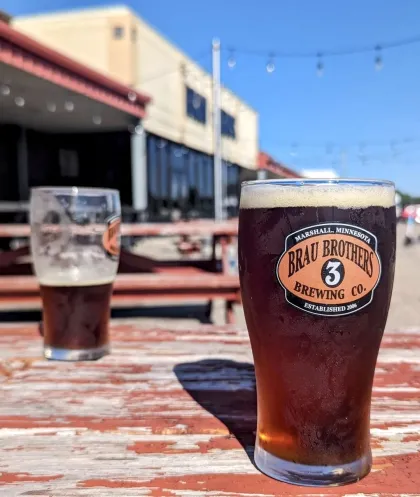
 A couple pints on the patio at Brau Brothers Brewing Co.
A great home base for your trip is Marshall, which offers resources on hunting in the region, including permits, regulations and safety guidelines (you can also check the Minnesota Department of Natural Resources website).
In town, you’ll find plenty of lodging and dining options. Brau Brothers Brewing Co. is a local favorite for beer, burgers and scratch-made pizza (plus two golf simulators). For coffee and baked goods, try Bagels and Brew or Main Stay Café & Coffee Co. Other local favorites include Hunan Lion Restaurant, Wings Axe Company, Sabor Latin Kitchen and Atlantic Place.
While you’re in southwest Minnesota, don’t stop with pheasants. The prairielands also offer excellent wild turkey hunting in spring and fall, along with opportunities for waterfowl and grouse.
-
Peep rare tallgrass prairies
 Touch the Sky Prairie / Credit: Paul Vincent
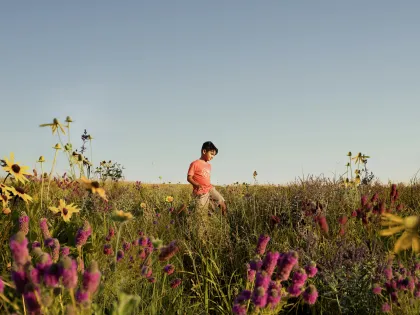
Minnesota is well known for its lakes and Northwoods — but if you stop there, you’re missing one of its most remarkable landscapes: the prairies. In southwest Minnesota, grasses and wildflowers ripple across the horizon like waves on water.
Once spanning more than 170 million acres across North America, native tallgrass prairie has been reduced to less than four percent of its original range, making it one of the continent’s most endangered ecosystems. In Minnesota, less than one percent remains. Fortunately, public and private partners across the state are working to conserve, restore and protect prairie ecosystems, which support a remarkable diversity of plant and animal life. A 2012 study even found that prairie grasslands can harbor more plant diversity in a small area than tropical rainforests.
There are several places across the state to experience native prairie. For a standout stop in southwest Minnesota, visit Touch the Sky Prairie near Luverne — a 1,000-acre restored preserve managed by the U.S. Fish & Wildlife Service as part of the Northern Tallgrass Prairie National Wildlife Refuge.
“The prairie is one of those plainly visible things that you can’t photograph.... [The] landscape embraces the whole of the sky.”
— Minnesota author Paul Gruchow
Other standout destinations include Hole in the Mountain Prairie Preserve in Lake Benton, home to more than 200 species of wildflowers and 25 species of butterflies; Jeffers Petroglyphs, where trails wind through restored prairie; and Camden State Park in Lynd, a favorite for hiking, mountain biking, trout fishing and swimming.
Each season brings a different character to the prairie, making it worth more than one visit. For sweeping wildflower displays, come in spring and summer. In fall and winter, grasses turn shades of gold and bronze. The prairie is rarely quiet — songbirds, insects and other wildlife create a constant, subtle soundtrack.
In southwest Minnesota, it’s always a good time for a little prairie-bathing.
-
Catch site of a quartzite cliff
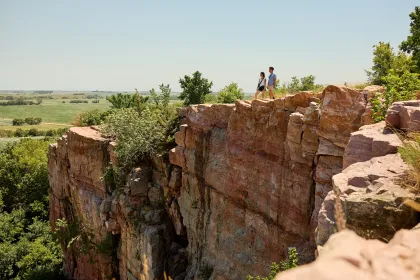
A couple hikers stand atop the quartzite at Blue Mounds State Park / Credit: Paul VincentThe first time you see a 100-foot cliff rising from the prairie, you may stop in your tracks. The quartzite cliffs found at Blue Mounds State Park and Pipestone National Monument are nothing short of awe-inspiring.
These cliffs — which can appear purple, red or pink — formed nearly two billion years ago, when ancient sand was compressed into an extremely hard rock called quartzite. Over time, rivers, inland seas and massive glaciers shaped and exposed the formations, leaving behind the striking cliffs we see today.
Freeze-thaw cycles later fractured the stone, creating boulders and climbable faces. Today, visitors can boulder, top-rope and trad climb on the quartzite at Blue Mounds — one of six Minnesota state parks that offer rock climbing.
-
Look and learn at Jeffers Petroglyphs
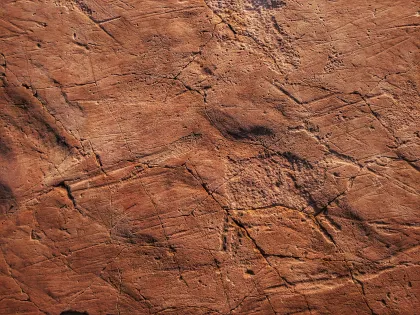
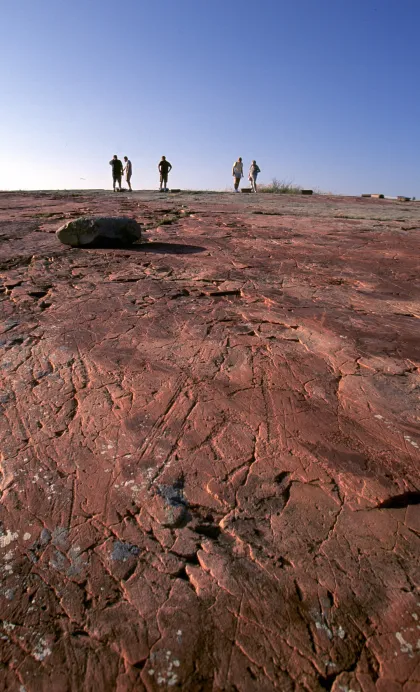
The Jeffers Petroglyphs site is marked by over 2,000 carved images of human figures, tools and animals / Kyle KrenzAmid the region’s prairielands are islands of uncovered rock, where the ancestors of today’s Tribal Nations left carvings of humans, bison, elk, turtles, atlatls and more. Also known as petroglyphs, these depictions tell a story that spans more than 7,000 years.
At Jeffers Petroglyphs in Comfrey, visitors can explore more than 5,000 Native American images carved into quartzite outcrops. The petroglyphs, which appear to range from 5000 BCE to 1750 CE, represent both the Native American history of the region and the landscape’s spiritual significance. This long span of time (7,000 years) makes Jeffers one of the oldest continuously used sacred sites in the world, if not the oldest.
Start your time at the visitor center, where you can explore exhibits on the region’s Native peoples and native prairie ecology. For a unique experience, learn about the atlatl (spear-thrower) at a hands-on atlatl range, which is open when staff are available. A museum store is also located at the visitor center.
 Jeffers Petroglyphs
Next up is a tour of the rock face at Jeffers. Visitors can take a self-guided tour using a booklet available at the visitor center and by following signage along the way, though a guided tour is highly recommended. During the 45-minute walking tour, staff highlight various carvings and share history from local Tribal Nations, as well as archaeological context.
During the summer months, Jeffers offers unique guided tours, including two sunrise options and a barefoot walking tour. For armchair travelers, you can also view the petroglyphs from home via an online virtual tour.
Around the site, visitors will also find 33 acres of native prairie and 47 acres of prairie restoration — one of the first such projects in Minnesota. You can explore the prairielands via three accessible trails ranging from 0.25 to 1.25 miles. Jeffers is generally open April through October; days and hours vary, so be sure to check ahead. Admission ($12 and under) can be purchased on-site.
-
Tour a town with more nutcrackers than people
A few of the many nutcrackers on display in LuverneLuverne is fast becoming America’s Nutcracker Capital, thanks to the Rock County History Center collection of more than 6,000 nutcrackers. Today, nutcrackers outnumber the town’s population of around 5,000, and the collection is one of the largest and most diverse in the world. The latest addition: a 65-foot-tall nutcracker statue standing proudly in downtown.*
While in Luverne, make a stop at the Brandenburg Gallery to admire the work of Minnesota’s most famous photographer, Jim Brandenburg. The Luverne native spent 30 years with National Geographic, and the gallery showcases images of the southwest prairies, Northwoods and beyond.
While free to the public, proceeds from the Luverne gallery support the Brandenburg Prairie Foundation, whose mission is “to educate, expand and promote native prairie in southwest Minnesota.”
After sightseeing, grab a coffee, sandwich or baked good at WildFlowers Coffee Boutique. For something more substantial, stop at Howling Dog Saloon for bison burgers, or Pizza Ranch for a slice. Take 16 Brewing Company, located on Main Street, also offers pizza, snacks and ice cream alongside a wide selection of brews.
* As of early 2026, the statue is halfway complete. Check the nonprofit Just for Nuts for the latest construction updates.
-
Pay tribute to the past at Mountain Lake Heritage Village
 Heritage Village in Mountain Lake
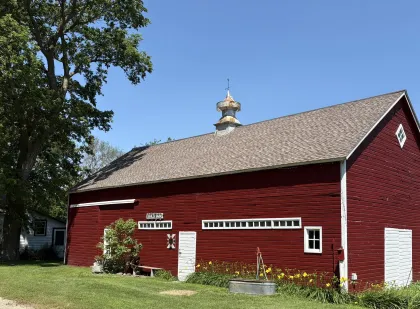
A 20-minute drive from Jeffers Petroglyphs, you’ll find a chance to step back in time at the Heritage Village in Mountain Lake. Founded in 1972, this immersive museum shares what life was like for settlers in the Prairieland region dating back to the 1800s. Visitors can tour 21 historic homes, along with a chapel, schoolhouse, depot, stores and other buildings that depict the lives of Russian Mennonite and German Lutheran immigrants who were among the area’s early settlers.
Heritage Village is also home to the Minnesota Hall of Fame Telephone Museum, the only one of its kind in the state. It offers a look at the evolution of the telegraph and telephone through the history of local telecommunications.
Admission is free, and the village is open Memorial Day through Labor Day (daily from 1 to 5 p.m.). On the second Saturday of September, Heritage Village hosts Heritage Fair, when costumed guides share the history of each building and its exhibits.
-
Become a train nerd
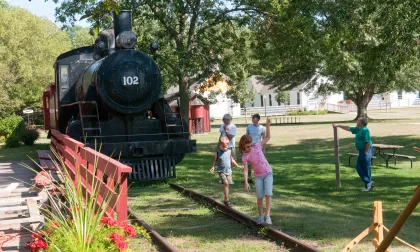
 End-o-Line Railroad Park and Museum in Currie
Minnesota has a long and proud railroad history. At one point, two major transcontinental lines — the Northern Pacific and Great Northern — called the state home. Train fans can revisit this storied past at Currie’s End-O-Line Railroad Park. This fun and educational destination features more than 13 historic buildings and structures that preserve the railroad history of the Currie and Shetek area in the 20th century. Explore a working manual turntable, authentic depot buildings and original railroad tracks that once connected prairie communities.
The park is open May through October with both guided and self-guided tours; hours vary by season. While in the area, stop by Pelican Cove on Lake Shetek or Key Largo for a bite to eat with views of Lake Shetek.
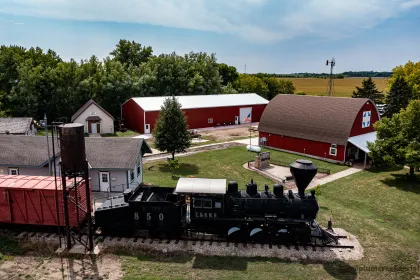
Credit: Wheels Across the Prairie MuseumIn nearby Tracy, the Wheels Across the Prairie Museum shares information and memorabilia from the Chicago and North Western Railway, which was built through southern Minnesota in the mid- to late 1800s to connect Winona to the Dakotas. The museum features a restored train depot, a four-unit freight train, a turn-of-the-century boxcar and caboose, as well as restored barns, buildings and items (such as tractors and antique automobiles) showcasing the town’s history.
About an hour away in St. James, railroad lovers can dive even deeper at the Roundhouse, home to detailed model railroads and historic railroad artifacts. Located next to the Railroad Depot Museum, this volunteer-run space showcases railroading down to the finest detail, with displays focused on historical accuracy and preserving the industry’s heritage.
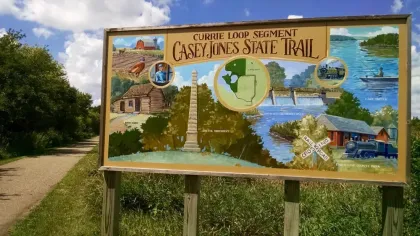
 Casey Jones State Trail / Credit: Parks & Trails Council of Minnesota
The Roundhouse is open weekends from Thanksgiving to Christmas and during St. James Railroad Days in June. We strongly recommend calling ahead to confirm hours.
For one more fun rail-related stop, head to the Casey Jones State Trail in Pipestone. Named after the famed railroad engineer, the longest 12-mile segment of the trail follows an old railroad grade — making it the perfect place to walk, bike or snowmobile along a piece of real railroad history.
-
Surf "the nation’s fastest wind"
 Worthington's annual Windsurfing Regatta & Music Festival / Credit: Forward Worthington
Some of the best windsurfing conditions in the world can be found in the unassuming town of Worthington. Lake Okabena, a 975-acre lake in the heart of town, benefits from strong prairie winds, often reaching 15 knots or more, making it ideal for windsurfing. That’s why the community has hosted the U.S. Windsurfing National Championships four times and counting (2003, 2008, 2014 and 2019).
While you can windsurf any day the weather cooperates, Worthington celebrates its love of the sport each June during the annual Windsurfing Regatta & Music Festival. Since 1999, the festival has promoted the windsurfing industry and supported both competitive and recreational sailing.
The regatta is the heart of the event — a nationally recognized competition that draws top racers from around the world. Visitors can also enjoy live music, an art fair, food vendors and even try windsurfing for the first time. Plus, it’s free to attend; just pack a lawn chair and beach bag and enjoy.
Windsurfing isn’t the only reason to visit Worthington. This agriculture-centered and highly diverse community hosts celebrations year-round. Every July, the town celebrates its diversity during the Worthington International Festival. Visitors can enjoy music and food from around the world, a talent contest, kids’ activities and more. Since 1939, King Turkey Day in September has highlighted Minnesota’s status as the top turkey-producing state in the U.S.